Objects can take the motion of these curves in space.
Scalar Field
A scalar field is defined as a function
An example would be . It maps every coordinate to a number.
Vector Field
A vector field is defined as a function
An example would be . A vector field maps every coordinate in space to a vector.
Line Integral
Line Integral over Scalar Fields
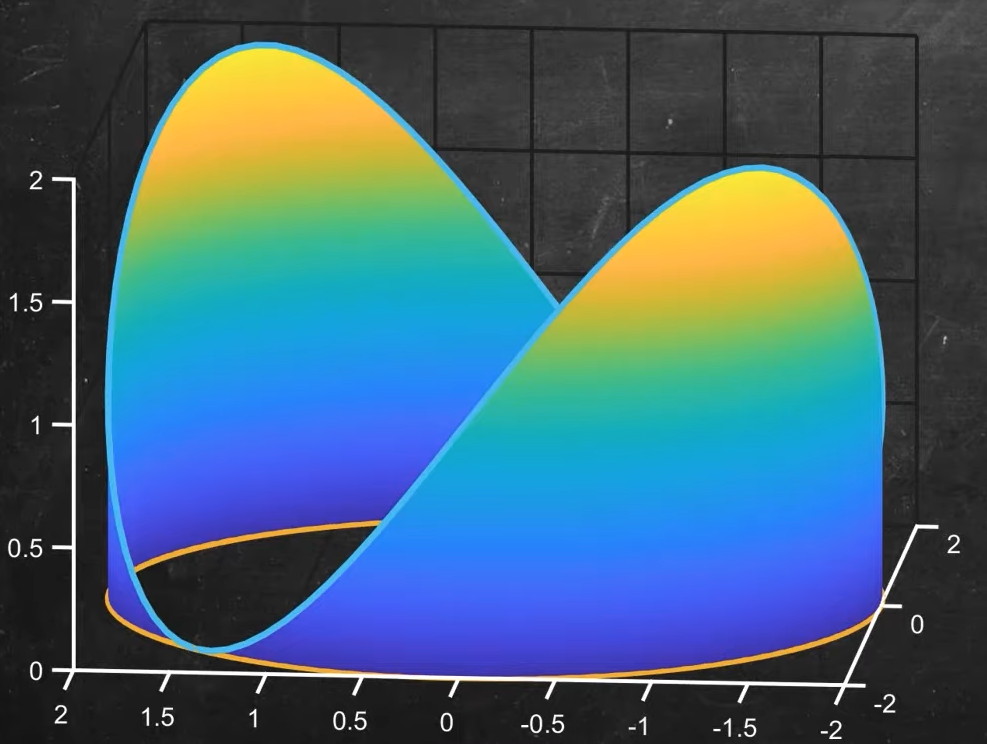
What is the Surface area of this shape?
A function is defined over . is traced out as the orange line on the x-y plane. And we want to find the area under this closed loop.
Let be a small arc-length along the curve . Where . If we integrate around the contour , summing up the product of and . It is clear that we get the surface area.
We can also rewrite the Surface area as
since
Thus
Line Integral over Vector fields
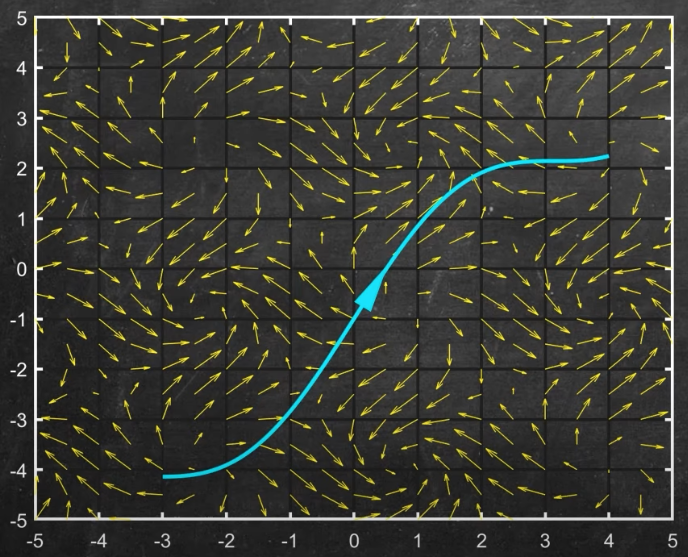
Supposed we have a vector field and a path an object takes .
The line integral of the vector field is to calculate the work done by the vector field in the direction of the object's motion.
Work done is defined by the product of distance and the force acting in the direction of movement.
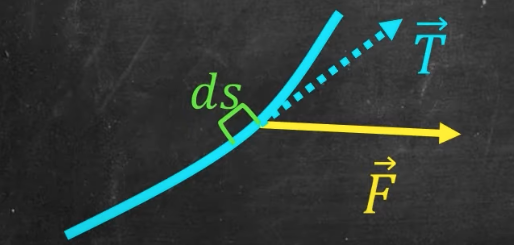
Assume a small particle moves distance , with a direction unit vector of whilst experiencing a force .
The contribution of the field along the segment is
The summation of WD along the contour is. (Sometimes this is called flow integrals as it measures how much the vector field flows along the line C)
If Thus,
Thus
We can also rewrite the Line integrals as such
Gradient Vector Field over Scalar Functions
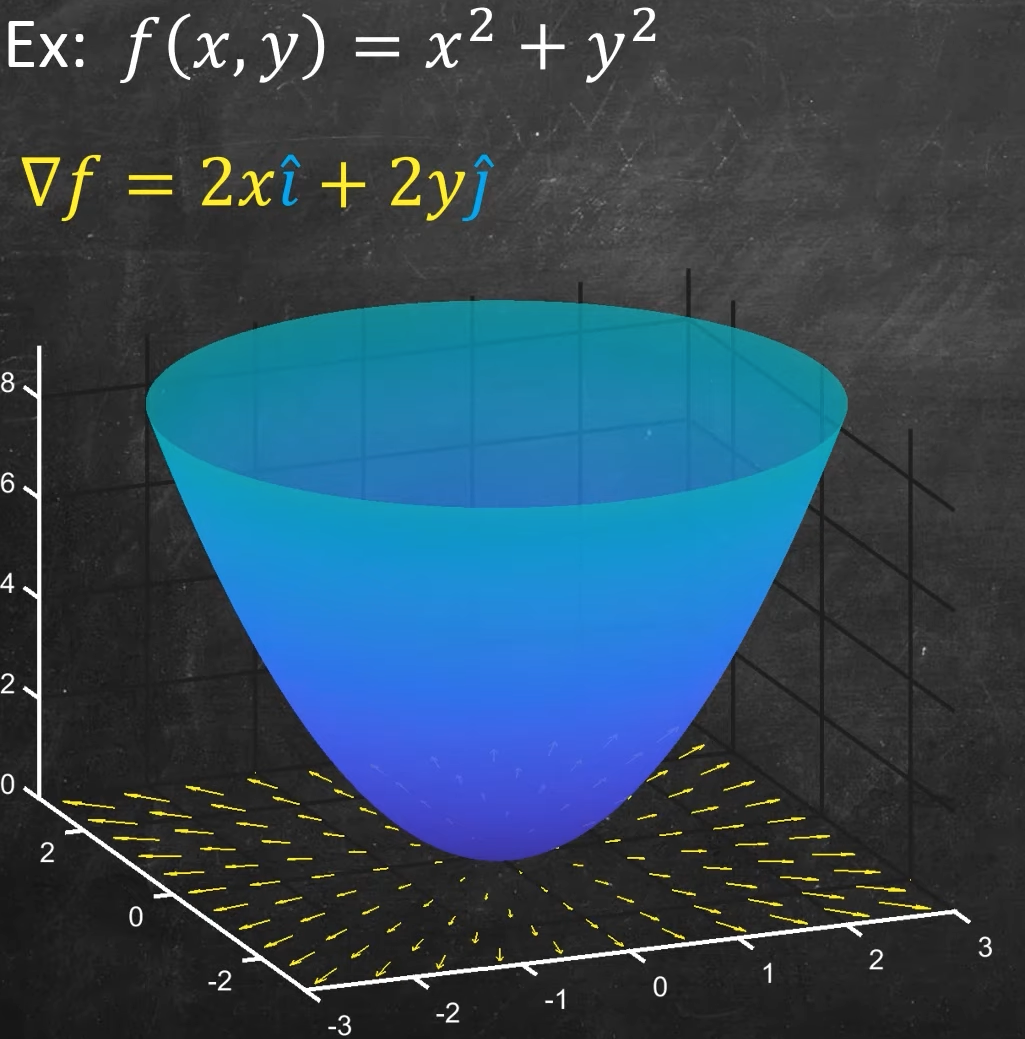
Given a function , The grad of a Scalar field will generate a vector field.
where
The gradient vector points in the direction of steepest increase. The length tells us how fast is changing in the direction
Side Note
If the Contour is closed (a loop), we express the integral as
Circulation
Circulation can be defined using flow integrals. Where we find how much a vector field flows along a closed contour (typically a circle)
The problem is that we can only find the circulation for a macroscopic object (like a big circle). What if want to find the circulation at a point?
What is the degree of circulation at a point?
if
Recall that
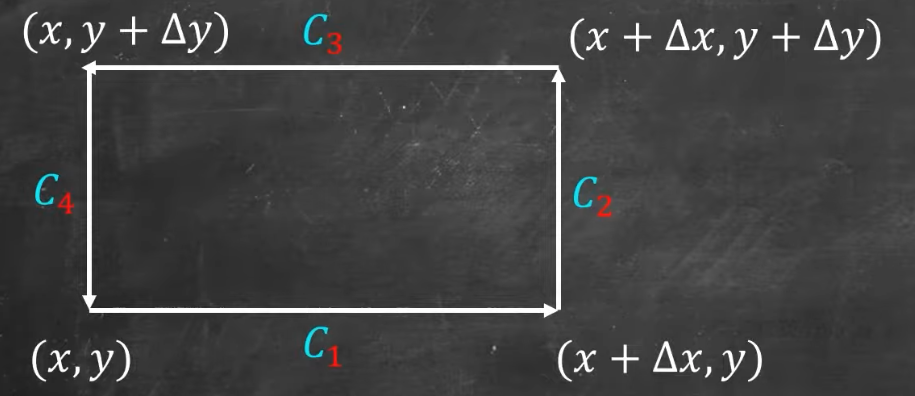
Imagine a infinitesimal region, and we want to find the circulation at that region.