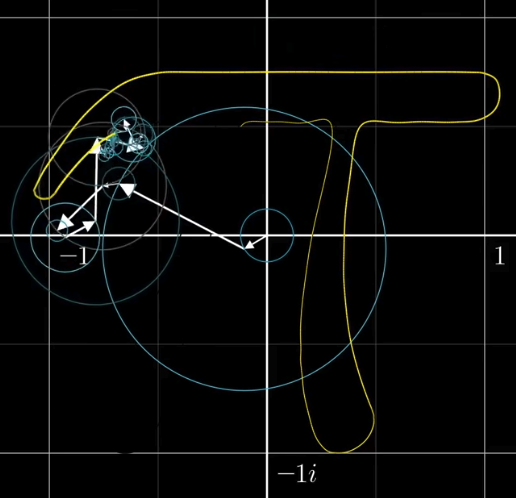
A Fourier series allows you to decompose a periodic function into a sum of complex sinusoidal waves of frequencies that is integer multiple of its fundamental frequency.
Introduction
We can express any closed function as a vector sum of rotating circles moving at different speeds, initial angle and amplitude.
Note
For a function . It is rotating times about the origin within a span of
So any function can be expressed as , . Where is a linear combination of rotating complex numbers in the form of where
or more simply
In addition, since
thus
However, if .
To find we can take the integral of from to .
In addition, to find , we can take the integral of from to .
Thus, we essentially make the integral in the expression equate to 1. More generally